| Rome was the venue for 1991,
with a particularly busy and tacky stage set. Italy's insistance on
using the Italian language (and a pair of particularly unhurried and
incompetent presenters who insisted on conducting a lengthy
introduction of each act after the postcard) meant for an especially
over-running contest, and at times a rather painful ordeal. It wasn't
helped that the voting resulted in a tie between France and Sweden, the
latter winning on a Formula One style count-back of most 12pts, 10pts,
etc. Under the current tie-break system based on the number of juries
from which votes were garnered, France would've won. Fortunately, the
1991 rules meant that the better song of the two secured the victory. Sweden's Carola, a sort of lightly spangled Robin Hood principal boy, faced off to a wind-machine for a competent swinging and pacy pop number with some considerable choreography (incorporating two besuited male backing dancers) and a good false-start key change. More interesting was the entry from Norway performed by four-piece vocal group Just 4 Fun (one of the male members compensating for the other in the hair department). It was a cheeky, quirky number with the title "Mrs. Thompson" cropping up at regular points during the chorus. There are few things more amusing than English words appearing amidst foreign speech; something which the writers of this song clearly appreciated. The brass section had a lot of fun too. Turkey's entry is a particularly whacky and fun twist (almost a Yugoslavian entry in that respect). It's a lot easier to pick up the dance moves to this than to the Swedish entry. And it's so adorably light and sweet, like a little lemon-drizzle bun. It's also at a high enough tempo that they can squeeze in about eleven more verses than everybody else. Across the Aegean, the Greek's have a very different approach. Their entry starts off with the sort of music you get in a news bulletin before Sophia Vossou enters with her haunted strains, reminiscent of '90s gothic 6th-form pop but with the intensity of a Eurovision power-ballad. An old man on a sax, possibly pissing himself with laughter, possibly just choking on his own saliva, delivers an incomparable solo that was surely not as-written. It's emotional stuff, with breathtaking string arrangement, and then she starts skatting (maybe there was supposed to be another sax solo but she made an editorial decision). It's powerful and moving stuff. Our winners were Israel, with an up-beat folksy duet. Good old Israel, still Israel after Turkey gave up being Turkey. It's all fairly conventional Israeli fare, suitably minor with a klezmerish tinge and a beat. Then there's a flourishing key-change, and an electric guitar; the backing vocalists march up and suddenly there's six of them. Another key change follows, because one can never have too many, and Israel's reputation is securely upheld. For each year's songs we apply our points in the 12-10-8 style of the modern contest, irrespective of how the voting functioned at the time. In brackets is the position the song came on the night:
As mentioned above, Europe had France second, with Spain fourth, Switzerland fifth, Malta sixth, Italy seventh, Portugal eighth, Ireland joint-tenth, Luxembourg 14th, Iceland 15th, Germany 18th, Denmark 19th and Austria last on nul points.
|
 Europe's winner, Sweden's Carola. 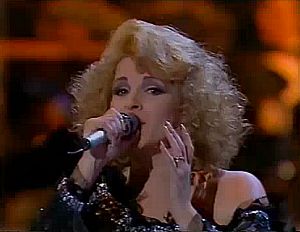 Greece's Sophia Vossou, a saxophonist down. 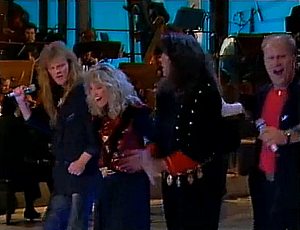 Just 4 Fun. 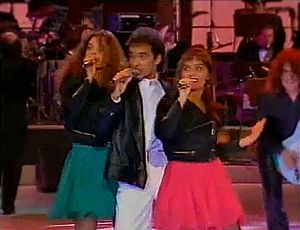 Çeliköz, Karaca & Uğurluer. 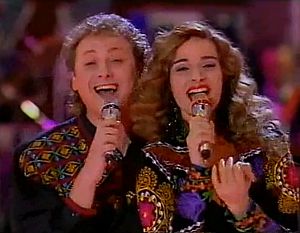 Our winners, Israel's Duo Datz.  Our hosts, former winners Cinquetti & Cutugno. You'll want to maim them. ⇦1990 / HOME / 1992 ⇨ |


